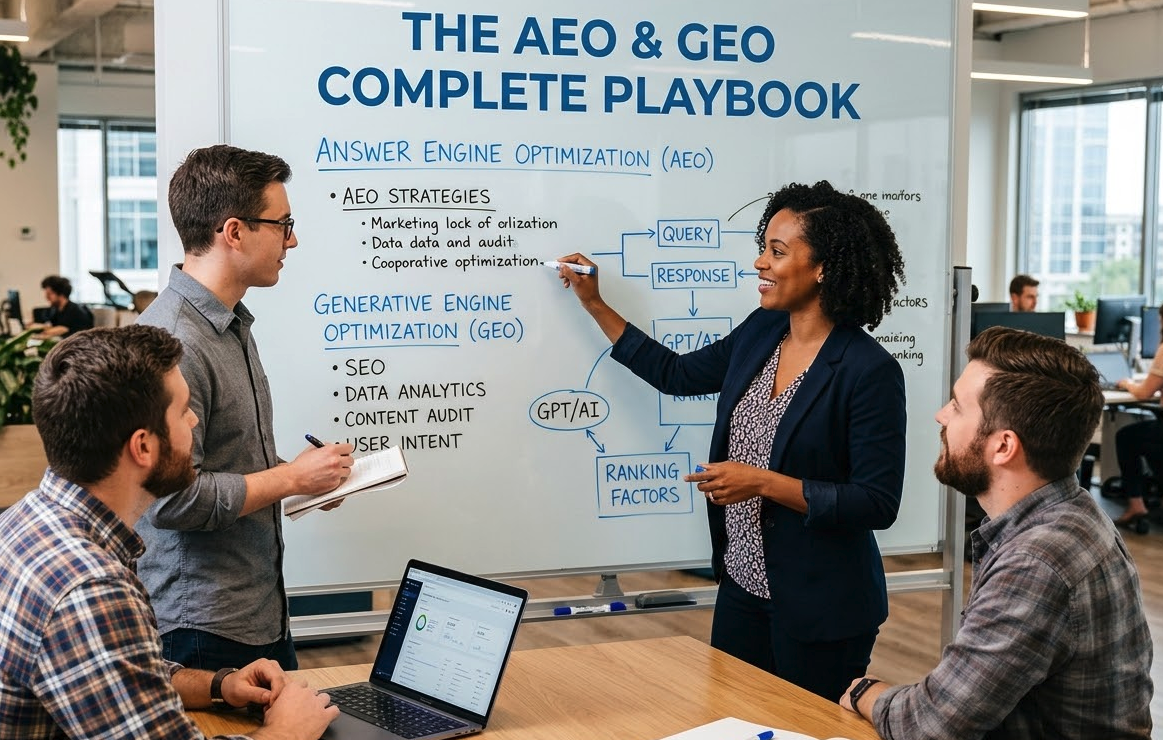


The rise of generative engines has revolutionized search experiences. Unlike search engines that primarily present 10 website links per page, along with map pack results, generative engines provide a summarized, multimodal response, compiling information from a variety of websites. AI-generated responses may also include citations and links to sources to back up their information. For marketers and business owners, this creates a dilemma: should they focus on GEO or stick with their SEO strategies? In this blog, we will explore the differences between GEO and SEO and discuss a few ways brands can leverage these concepts for better visibility.
What is Search Engine Optimization (SEO)?
SEO, search engine optimization, is the process of optimizing your website for better visibility and ranking on search engines like Google. Traditionally, when a user searches a query, search engines present results in the form of 10 organic links, in addition to a few sponsored links. They may also present results in other forms, such as results in a map pack, depending on the search intent. To ensure their website ranks among the top 10 organic results, preferably in the first three positions, business owners and marketers leverage SEO, which includes on-page elements, technical optimizations, backlinks, and more.
The Goal of SEO
The goal of SEO is pretty simple:
- Increasing visibility in SERPs: SEO aims to help your website rank on the first page of search engine results pages (SERPs) or in map packs.
- Targeting organic clicks and keyword rankings: SEO success involves increasing organic traffic to your website and ranking higher in the SERPs for as many relevant keywords as possible.
SEO Core Components
SEO is a complex concept. Its success depends on a few components that need to be in the best possible condition for your website to rank.
- On-page optimization: On-page optimization is the process of optimizing individual web pages to rank higher for relevant keywords. This includes improving your website’s content, internal linking, page experience, and site architecture.
- Technical SEO: Technical SEO involves improving your website’s technical aspects to improve its crawlability and indexability. Site speed, performance, mobile-friendliness, security protocols, and structured data are some crucial aspects of technical SEO.
- Off-page SEO: Off-page SEO involves actions taken outside of your website to improve your website’s search engine visibility. Common off-page SEO tactics include brand mentions, backlinks, citations, social media, and digital PR.
- Content quality and E-E-A-T: Content quality is crucial to improving your website’s SEO. Search engines like Google look at your content’s experience, expertise, authoritativeness, and trustworthiness (E-E-A-T) to assess how well your content meets the needs of your users.
What is Generative Engine Optimization (GEO)?
Generative engine optimization (GEO) is the process of adapting your website’s content to improve its visibility in generative AI search engines, such as ChatGPT, Copilot, and Perplexity. Previously, website owners focused on ranking in SERP results. However, in the current market, generative engines are becoming an increasingly common part of search practices. Therefore, marketers are starting to use GEO strategies to increase the visibility of their websites in AI-generated content.
Where GEO Works
GEO is a strategy for gaining visibility across various generative engines. These engines include:
- Google SGE (Search Generative Experience): GEO is a good way to get visibility on Google Search Generative Experience (SGE), which includes AI Overviews and AI Mode.
- ChatGPT & Perplexity: ChatGPT and Perplexity are two of the fastest-growing generative AI platforms. These platforms also heavily link to other sources, which is why marketers use GEO to target these engines.
- Copilot: Copilot is an AI engine that relies on Bing’s search capabilities to respond to users’ queries. The goal of GEO is to make content relevant and authoritative enough so that it ranks on Copilot answers.
- AI-powered shopping and travel search: Shopping and travel platforms are increasingly using AI to enhance customer experience and recommend services and products, which can be a game-changer for e-commerce and travel businesses.
GEO’s Core Goal
Similar to SEO, which focuses on organic traffic and search engine visibility, GEO’s goal is to increase visibility in AI engines through topical authority. Two primary goals of GEO include the following:
- Being referenced or cited in generative AI answers: AI-generated answers almost always link back to the sources that they get their answers from. The primary goal of GEO is to get cited or referenced in these answers as an original source.
- Focus on semantic authority, not just keyword authority: SEO typically focuses on ranking for relevant keywords. In GEO, marketers focus on semantic and contextual authority instead of keywords.
Why GEO Matters in 2026
Generative engines have taken the search market by storm, and we can expect further developments in AI in the near future. Here are a few key emerging trends:
- AI engines are overpowering search engines, reducing organic clicks: There has been a significant shift in the search market. To provide immediate value to users, traditional search engines like Google are now prioritizing AI-generated overviews and summaries rather than directly listing links. This lack of links is why brands are losing organic clicks.
- Early adoption of GEO gives a competitive edge in AI-driven discovery: The AI-driven search market is growing and will continue to grow. Brands that want to cater to users across all types of search engines have to adopt GEO before it’s too late.
- How brands can stay visible as click-based SEO declines: There has been a noticeable decrease in organic clicks over the last few years. As click-based SEO declines, brands need new strategies to stay visible in the search market, which is where GEO comes in.
Key Differences Between SEO and GEO
Although SEO and GEO are both intended to increase a website’s visibility, there are some key differences between them.
Focus
SEO focuses on keyword authority, on-page optimization, and backlinks to boost rankings. On the other hand, GEO focuses on semantics, topical authority, and contextual relevance to gain visibility on generative AI engines.
Tools Used
Various tools are used in SEO for keyword research, site audits, and competitor analysis. These tools help track performance, backlinks, and technical issues. GEO typically uses extended versions of SEO tools that incorporate AI tracking, as well as dedicated GEO and AIEO platforms.
Measurement
To measure performance, the key metrics and KPIs in SEO are organic traffic, keyword rankings, click-through rates (CTRs), conversion rates, bounce rates, and page load speed. Key metrics of performance measurement in GEO include the AI visibility index and the share of references in AI-generated answers.
How GEO Complements SEO
Although GEO is different from SEO, you don’t have to choose one or the other. Instead, GEO complements SEO in various ways. When you’re creating pillar content, comprehensive guides, and thought leadership content, both GEO and SEO are crucial. While SEO depends on long-form, page-level content, GEO requires comprehensive content semantically chunked to support users’ queries. That is why pages with extremely detailed content often have text boxes and TL;DR sections to summarize things. Content that performs well on generative engines—clear headings, fact-checked information, cited answers, no fluff—performs well for traditional SEO as well because it aligns with E-E-A-T and Google’s helpful content guidelines.
How to Optimize for Generative Engine Optimization with SEO
The good news is that you can actually write content in a way that supports both SEO and GEO. The key is to have a proper framework that combines SEO value and GEO attraction.
Build a Strong SEO Foundation
Most generative AI platforms take their sources from an existing database. Gemini uses Google’s search database, and Copilot uses Bing’s. Therefore, having a strong SEO foundation enabling you to rank in search databases directly complements your GEO efforts. Some crucial components of a strong foundation include a good internal linking structure, high-quality page content, credible backlinks, and technical optimization.
Focus on E-E-A-T and Trust Signals
Google uses a framework called E-E-A-T to assess the quality of web content. This framework stands for expertise, experience, authoritativeness, and trustworthiness. The best way to meet these standards and get the maximum number of trust signals from Google is to create content that is factual, unique, and relevant to your website and your users, thereby establishing your topical authority. Your website should be engaging, offer a good user experience, and receive votes of confidence (backlinks) from other sites. High-quality content will increase your visibility on SERPs and increase the likelihood that AI engines will cite your website as a source.
Create “Answer-First” Content
Generative engines are built on an answer-first approach. They are designed to immediately satisfy a user’s query without wasting time on redirecting them to sources. That is why most AI-generated answers start with “Yes” or “No” and then go into detail. If you want AI engines to extract information from your website, you need to follow the same approach. Make your H2s and H3s more descriptive and question-oriented. In the body content, eliminate fluff and dive straight into the answer.
Optimize for AI Queries, Not Just Keywords
Queries on AI are more conversational and informational. A user is likely to ask follow-up questions or to reframe their queries to get the exact information they need. This is an opportunity for websites to optimize for AI queries rather than focusing solely on keywords. For instance, if you are writing a page on a specific topic, answer questions based on long-tail keywords in a conversational tone. You can also add relevant FAQs to your page to address common queries and follow-up questions.
Monitor AI Overview Citations
Since Google is the biggest search engine in the market, and AI Overviews dominate most search queries on Google, it’s easier to rank for overviews than other generative engines that take information from other databases. As you put GEO in practice, start monitoring your rankings and citations on AI Overviews. Many SEO tools now provide options to track your performance on AI Overviews and other generative engines.
GEO, AEO, and SEO: The Future of Search Optimization
Search experiences have been changing dynamically in the last few years, but the good thing is that your efforts in any one area don’t have to compete with your efforts in another. You can focus on both GEO and SEO with updated optimization strategies. A unified strategy accounts for key practices that help you become visible on AI engines and in traditional search results. With the rise of platforms like ChatGPT, Gemini, and Claude, the generative engine market is only expected to grow. It’s time for brands and businesses to leverage GEO and AEO, combined with SEO, in order to increase their online visibility.
Final Thoughts
GEO and SEO are similar; they both focus on search visibility. Despite their differences, GEO complements SEO, which is why it’s important to focus on a unified strategy that supports both. The key is to build a strong SEO foundation with robust technical optimizations that integrate answer-first content and AI query optimization. If you don’t know where to start, Outpace can help. Talk to an expert today.
Frequently Asked Questions (FAQs)
No, GEO does not replace traditional SEO. It just adds another layer. With the rise of generative AI platforms, websites now must optimize for search engines and also for generative engines.
Many traditional SEO tools now incorporate GEO monitoring features to help brands track their performance across AI Overviews and generative engines.
Small businesses can effectively use GEO by creating conversional, semantically-chunked, and answer-first content on their websites. They need good SEO fundamentals paired with structured data, schema markup, and AI query optimization to rank effectively in generative engines.
Backlinks play a prominent role in both SEO and GEO. In SEO, backlinks are a ranking factor that helps build your domain’s ranking and authority. In GEO, backlinks serve as a trust signal that signals to generative engines that your content is credible and trustworthy enough to be cited.
Citations
- Ngugi, L. (2025, October 29). GEO vs. SEO: Key Differences and Importance in Digital Marketing. SEO.com. https://www.seo.com/ai/geo-vs-seo/
- Taylor, D. (2025, July 28). SEO vs. GEO: What’s different? What’s the same? Search Engine Land. https://searchengineland.com/seo-vs-geo-459474