
Search has changed more in the past 18 months than in the previous decade combined. Google’s AI Overviews (formerly Search Generative Experience) are now live in the United States and expanding globally. ChatGPT, Perplexity, and Claude are answering questions that used to drive clicks to websites. Zero-click searches, where users get their answer directly from the search results page without visiting any site, now account for over 65% of all Google searches according to SparkToro research.
If your SEO strategy was built for the search landscape of 2022, it is already partially obsolete. Not entirely. The fundamentals of SEO have not changed. But the tactics, the metrics, and the competitive dynamics have shifted significantly, and the businesses that adapt now will have a meaningful advantage over those that wait.
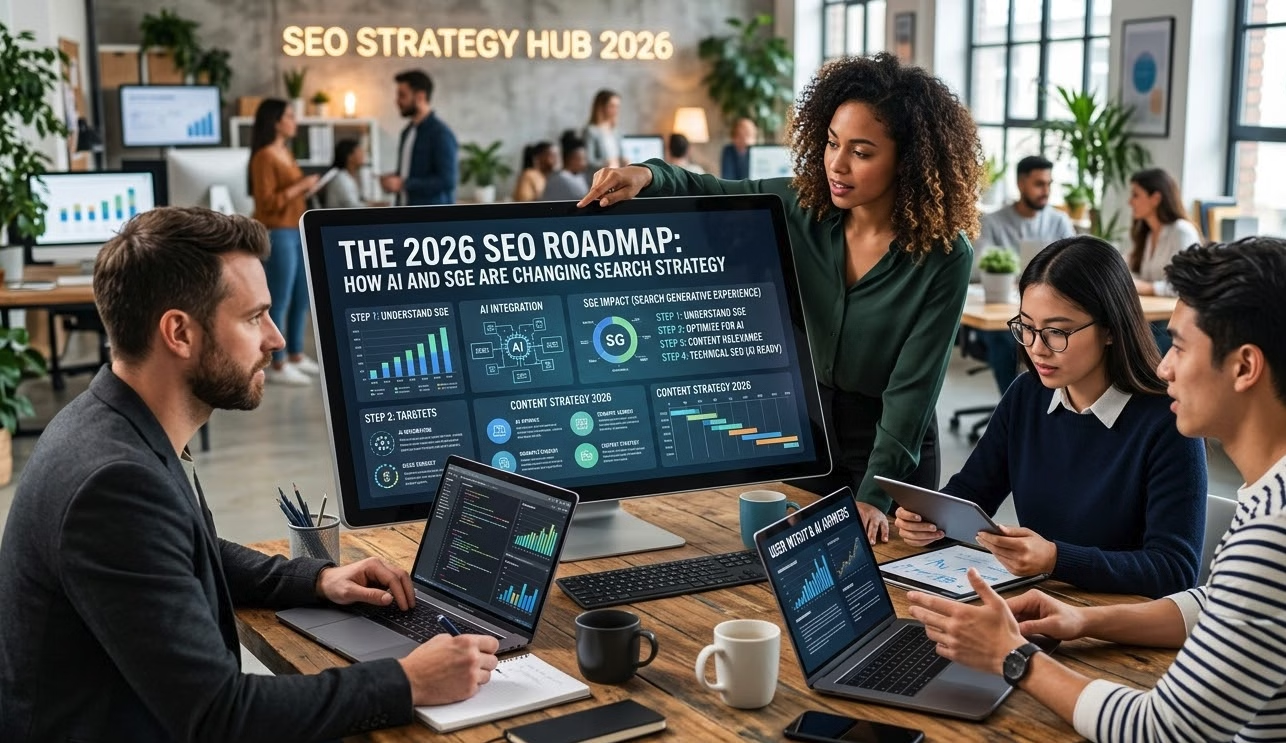
This is the 2026 SEO roadmap. Not a prediction. A strategic framework based on what is already happening and where the data points.
What AI Overviews Actually Mean for Organic Traffic
The initial reaction to Google’s AI Overviews was panic. If Google is answering questions directly in the search results, why would anyone click through to a website?
The reality is more nuanced. Early data from multiple studies shows that AI Overviews appear primarily for informational queries, not transactional ones. Searches with commercial intent (“best HVAC company near me,” “buy running shoes online”) still produce traditional blue-link results with strong click-through rates. Searches with informational intent (“how does HVAC work,” “what causes knee pain”) are increasingly answered by AI Overviews, reducing clicks to informational content.
This has two important implications for your SEO strategy.
First, the value of ranking for purely informational keywords has decreased. If you have been investing heavily in top-of-funnel informational content primarily to drive traffic volume, that traffic is at risk. AI Overviews are absorbing a growing share of informational query clicks.
Second, the value of ranking for transactional and commercial intent keywords has increased. These are the queries that AI Overviews are not replacing, and competition for those rankings is intensifying as more businesses recognize this shift.
The strategic response is not to abandon informational content. It is to ensure your informational content serves a purpose beyond driving traffic: building topical authority, establishing brand familiarity, and creating the kind of expertise signals that influence both traditional rankings and AI-generated answers.
Generative Engine Optimization (GEO): The New Frontier
Beyond Google’s AI Overviews, a new category of search behavior is emerging: users querying AI systems like ChatGPT, Perplexity, and Claude directly for recommendations, comparisons, and buying guidance.
These systems do not rank websites. They synthesize information from their training data and real-time web access to generate answers. But they do cite sources. And the sources they cite are the ones that have established clear, authoritative, well-structured content on the topics users are asking about.
This is Generative Engine Optimization (GEO): the practice of structuring your content and building your authority specifically to be cited and recommended by AI systems.
The early research on what makes content more likely to be cited by AI systems points to several consistent factors:
Authoritative sourcing. Content that cites primary research, data, and expert sources is more likely to be treated as authoritative by AI systems trained to value credibility signals.
Clear, structured answers. AI systems are optimized to extract specific answers to specific questions. Content organized around clear questions and direct answers (FAQ format, structured headers, definition-first writing) is more extractable and more citable.
Entity clarity. AI systems understand the world through entities (people, places, organizations, concepts) and their relationships. Content that clearly establishes what your business is, what it does, who it serves, and what it is known for is more likely to be accurately represented in AI-generated answers.
Brand mentions and citations. The more your brand is mentioned, cited, and linked to across the web, the more likely AI systems are to recognize it as an authoritative source in your domain.
The 2026 SEO Strategy Framework
Given these changes, here is the strategic framework that will drive results in the current and near-term search environment.
Priority 1: Transactional and Commercial Intent Content
Double down on content that targets buyers, not browsers. Service pages, product pages, comparison pages, and local landing pages that target high-commercial-intent queries are the most protected from AI Overview disruption and the most directly connected to revenue.
Every service you offer should have a dedicated, comprehensive page optimized for the specific transactional queries buyers use. Every market you serve should have a location-specific page that addresses local intent. These pages should be conversion-optimized, not just ranking-optimized.
Priority 2: Topical Authority Over Keyword Volume
The era of ranking for individual keywords in isolation is over. Google’s systems now evaluate topical authority: how comprehensively does a site cover a given subject area? A site that covers HVAC comprehensively, from maintenance guides to equipment comparisons to emergency repair resources, will rank better for all HVAC-related queries than a site that has one well-optimized HVAC page.
Build content clusters. Each cluster should have a comprehensive pillar page covering a major topic and a set of supporting pages addressing specific subtopics. This structure signals topical authority to Google and creates the kind of comprehensive resource that AI systems cite.
Priority 3: E-E-A-T Signals
Google’s E-E-A-T framework (Experience, Expertise, Authoritativeness, Trustworthiness) has become more important as AI-generated content has flooded the web. Google needs signals that distinguish genuinely expert content from AI-generated fluff, and E-E-A-T is the primary framework for making that distinction.
Practical E-E-A-T signals include: author bios with verifiable credentials, original research and data, first-person experience and case studies, expert quotes and citations, and a clear organizational identity (About page, team pages, contact information).
Priority 4: Technical Excellence
AI Overviews and AI search systems pull content from pages that are technically accessible, fast-loading, and well-structured. A site with poor Core Web Vitals, crawl errors, or thin content is less likely to be cited by AI systems and less likely to rank in traditional results.
The technical SEO fundamentals have not changed. They have become more important.
Priority 5: Brand Authority and Off-Site Signals
The businesses that will win in the AI search era are the ones that have built genuine brand authority: consistent mentions across authoritative publications, strong backlink profiles from relevant sources, active and well-reviewed Google Business Profiles, and a recognizable brand presence that AI systems can accurately identify and recommend.
Link building is not dead. It has evolved. The focus should be on earning links from genuinely authoritative, relevant sources, not on volume or domain authority metrics alone.
What to Stop Doing in 2026
The 2026 SEO landscape also requires letting go of tactics that are no longer effective.
Stop optimizing for traffic volume from informational queries. If your content strategy is built around driving top-of-funnel traffic from informational keywords, you need to recalibrate around intent and conversion, not volume.
Stop treating AI-generated content as a shortcut. AI-generated content at scale is exactly what Google’s Helpful Content system was designed to demote. Using AI to produce large volumes of thin, undifferentiated content is not a growth strategy. It is a liability.
Stop ignoring zero-click search. Zero-click does not mean zero value. A brand that appears in AI Overviews, featured snippets, and knowledge panels is building awareness and authority even when users do not click. Optimize for visibility, not just clicks.
Stop measuring SEO success by rankings alone. In a world where AI Overviews, featured snippets, and local packs capture a growing share of search result real estate, a ranking position is a less reliable proxy for visibility and revenue than it used to be. Measure organic sessions, organic-attributed conversions, and revenue.
The Bottom Line
The fundamentals of SEO have not changed. Quality content, technical excellence, and genuine authority still drive results. What has changed is the competitive context: AI is raising the bar for content quality, shifting traffic away from purely informational queries, and creating new channels (AI citation, GEO) that reward the same underlying qualities that traditional SEO has always rewarded.
The businesses that will win in 2026 and beyond are the ones that build genuine expertise, serve their audiences better than anyone else, and invest in the kind of authority that no algorithm update can take away.
Outpace SEO builds strategies for the search landscape as it is, not as it was. Talk to us about what a 2026-ready SEO strategy looks like for your business.